
Immigrants, Refugees & Food Assistance
At San Diego Hunger Coalition, we are committed to helping every resident in San Diego County access the food assistance they need. We understand the growing concerns around applying for CalFresh (SNAP/EBT) and its impact on immigration statuses.
Starting September 18, 2026, changes to the public charge rules include more public benefits, including federal food assistance programs such as SNAP/EBT/CalFresh. The current administration now gives the U.S. Citizenship and Immigration Services (USCIS) additional discretion to evaluate which public services (i.e. healthcare, housing, food assistance, and more) family members are utilizing before approving green card applicants.
We encourage families to make careful decisions based on what is best for themselves and their families as well as consult legal resources (listed below) as needed.
As of September 14, 2026, California has joined 21 states in challenging the new public charge rule.
San Diego Hunger Coalition is committed to providing updated information as soon as possible. Please check back on a regular basis.
We encourage anyone with questions to reach out to us for support. Call 619.501.7917 or email info@sdhunger.org for assistance.
What is public charge?
Immigration officials assess whether a person is likely to become primarily dependent on the government for subsistence when applying for a visa, a green card, or certain immigration benefits.
The public charge test only applies to some programs and some immigrants:
It never applies to U.S. citizens
It also doesn’t apply to most people with a green card, or asylees, refugees, people with U visas, T visas, VAWA, and many others.
Additionally, changes to public charge immigration policy never alter immigrant eligibility for public benefits. Public charge decisions happen when someone applies for their green card or to immigrate to the United States.
Public charges only applies to:
Individual applying for a family-based green card
Those with a green card who plan to leave the United States for more than 6 months
For more information on whether public charge applies to you; please visit Protecting Immigrant Families website.
Please see below for additional information. We encourage individuals and families to contact a qualified immigration attorney if they have questions about their immigration case.
California Health and Human Services Agency’s New Public Charge Guide
CalHHS has released an updated public charge guide to serve as a resource for individuals and families with questions about the current federal public charge policy; visit CalHHS website to learn more about public charge.
These food assistance programs are not used to determine public charge. Please continue to access them as needed:
To learn more about these resources, visit: sdhunger.org/get-food
Resources
Protecting Immigrant Families: https://pifcoalition.org/
Use this guide to better understand if public benefits affect immigration options. This should not be construed as legal advice. Please consult a legal professional to determine what is best for you and your family.
Keep Your Benefits: Online Public Charge Screening Tool https://keepyourbenefits.org/en/ca/
This screening tool helps immigrant families and providers get the basic information they need about the public charge rule. It asks a series of questions that help immigrants understand how using public benefits may affect their immigration status, which benefits are safe to use, and when to seek legal advice. CA-specific information available in English, Spanish, and Chinese.
Read California Health and Human Services Agency Public Charge Guide

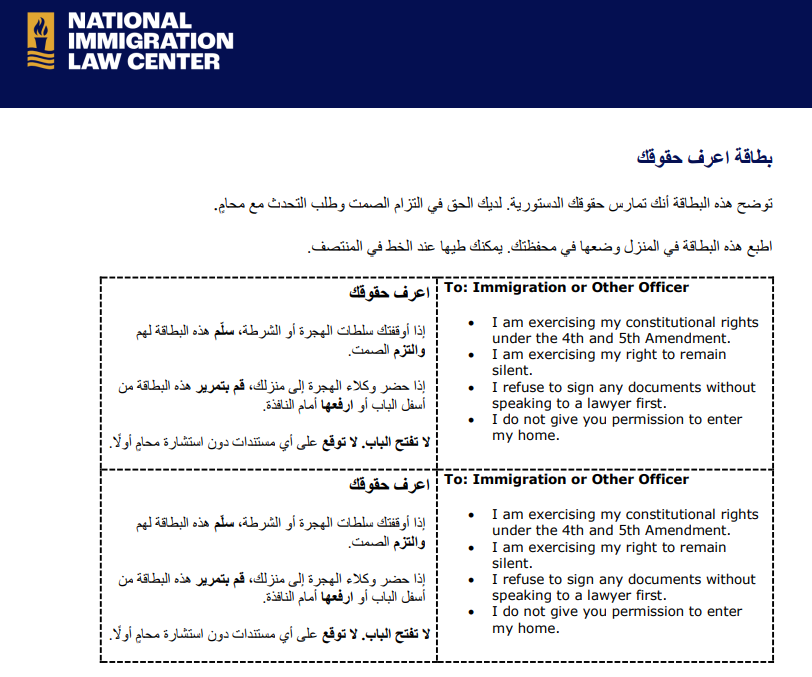
Get Your Know Your Rights Card
Everyone living in the U.S. has certain basic rights under the U.S. Constitution. Undocumented immigrants have these rights, too. It is important that we all assert and protect our basic rights.
The National Immigration Law Center provides its Know Your Rights card in English, Spanish, Arabic, Chinese (Simplified and Traditional), Haitian Creole, Korean, Tagalog and Vietnamese.
The Immigrant Legal Resource Center also has Know Your Rights "red cards" available on their website.
Frequently Asked Questions:
Trusted Legal Assistance - Who to Call
If you have questions about how public assistance may impact your immigration status, there are community agencies and resources that can provide information and advice specific to you and your family situation.
Alliance for African Assistance | (619) 286-9052 | 5952 El Cajon Blvd, San Diego, CA 92115
Alliance San Diego | (619) 269-1823 | 4443 30th Street, San Diego, CA 92112
Casa Cornelia Law Center | (619) 231-7788 | 2760 5th Ave., Suite # 200, San Diego, CA 92103
Casa Familiar | (619) 428-1115 | 119 W. Hall Ave., San Ysidro, CA 92173
International Rescue Committee
(619) 641-7510 x250 | 5348 University Ave, Suite #205 San Diego, CA 92105
(619) 440-6208 | 131 E. Main Street, El Cajon, CA 92020
Jewish Family Service of San Diego | (858) 637-3210 | 8804 Balboa Ave, San Diego, CA 92123
Legal Aid Society | (877) 534-2524 | 110 South Euclid Avenue, San Diego, CA 92114
URISE | (760) 477-7537 | 1600 Buena Vista Dr. Vista, CA
Who to contact if you or a loved one are arrested or detained:
Locate someone in county jail: https://apps.sdsheriff.net/wij/
Locate someone in immigration custody: locator.ice.gov
If non-detained - Immigrant legal services: www.immigrationadvocates.org/legaldirectory
If detained -San Diego County Immigrant Legal Defense Program: 619-446-2883
California Lawyer Referral Service (private attorneys): bit.ly/lawyer-directory
Immigration court case status and hearings: 800-898-7180 | acis.eoir.justice.gov.
Mexican Consular Assistance: 520-623-7874, https://www.gob.mx/ciam
List of other consulates in the US: bit.ly/embassycontacts
-
You may be eligible for CalFresh if you have been granted:
• U.S. citizenship
• A green card
• Cuban or Haitian entrant
• Citizens from the Federated States of Micronesia, the Republic of the Marshall Islands, and the Republic of PalauAn individual does not qualify for CalFresh if they are:
• An undocumented person
• Deferred Action for Childhood Arrivals (DACA) recipients
• Asylee or Refugee status
• On a student, work, or tourist visa.
• Here under Temporary Protected Status -
It’s possible that not all individuals in the household will be eligible for CalFresh, and that’s okay. If someone in the family is undocumented, eligible household members can still apply and receive benefits.
For example, if a father is undocumented and has 2 children with U.S. citizenship, the father can opt-out and apply on behalf of his children. He will never need to disclose his legal status at any point in time.
Some helpful reminders:
• Children who have citizenship or eligible immigrant status can receive benefits even if their parents are undocumented.
• If you tell your caseworker that a non-citizen in your family does not want to be considered for benefits, they are not allowed to ask for proof of their immigration status.
• It may be beneficial for families to speak with an immigration attorney if they have concerns about how applying will affect them.Important: If you are applying only for other people in your household, you don’t have to provide proof of your immigration status.
-
At this time, federal and state laws protect the privacy of people who apply for and receive CalFresh. The County of San Diego and California Department of Social Services will check to make sure you are eligible for the program, but they do not share information with ICE or immigration officials.
Your personal information is protected and only used to determine your eligibility for benefits. If you are applying for benefits only for another person in your family or household, you do not have to share your immigration status with CalFresh.
-
Documents that are usually required for CalFresh include:
• A copy of your ID
• Proof of any income from the last 30 days
• Proof of financial aid (for college students)Immigrants may also be asked to provide:
• A copy of your green card
• Naturalized U.S. citizens may be asked to provide a copy of their U.S. passport or naturalization papers
• Sponsor financial information IF family members apply for CalFresh have had a green card (LPR status) for five or more years.Additional documents that may be requested in order to receive a higher amount of benefits:
• Housing expenses
• Child support paid
• Child/dependent care paid
• Medical expenses if you are 60+ or disabledIf you don’t have the required documents: Your caseworker can help you obtain the necessary paperwork. If you are stuck or are not receiving the support you need, please contact calfresh@sdhunger.org.
-
A sponsor’s income and resources may need to be counted when you apply for CalFresh, but it depends on each household. Sometimes you will only be asked for a sponsor’s name, but no financial information.
• Depending on your legal status, you may need to provide your sponsor’s financial information. This will not affect your income or eligbility for CalFresh benefits.
• Sponsors may provide their financial information using the SAR 22 Form here.
• If you cannot provide your sponsor’s information and you make at or below 130% Federal Poverty Level, you may fill out the USCIS 09-99 Indigency Form here .• The 09-99 form is sent to USCIS; however, there have been no effects seen so far in the state of California.
The best way to determine if you need to include this information is by working with a trained CalFresh Application Assistor here who can help answer your questions.
-
In San Diego County there are more than 20 community-based organizations that have CalFresh Application Assistors who are trained to successfully complete the CalFresh application process, and many of them offer services in multiple languages. You can find a CalFresh Application Assistor that is closest to you at sdhunger.org/applying-for-calfresh.
The San Diego Hunger Coalition works closely with the County of San Diego to help make sure that anyone who is eligible for CalFresh gets it. If anyone has issues relating to CalFresh and have not connected with a CalFresh Application Assistor, they can connect with our CalFresh Team at calfresh@sdhunger.org.
-
Food distribution sites can be found throughout San Diego County. To find a distribution site near you, you can contact San Diego Food Bank and/or Feeding San Diego.
Please contact an immigration attorney if you have questions about how the new Public Charge rule affects you or someone you know.
Living in an Immigrant Family in America: How Fear and Toxic Stress are Affecting Daily Life, Well-Being, & Health - Click here to read the issue brief from The Henry J. Kaiser Family Foundation.
If your organization has any questions about the information provided on this page, please contact the CalFresh team at calfresh@sdhunger.org.